
Design, Performance and Application
Wills Wing offers a comprehensive range of control bar configurations, each engineered to deliver the optimal balance of aerodynamic performance, structural strength, durability, and cost for a specific glider model and intended use. Control bar selection has a measurable impact on handling, glide performance, setup practicality, and long-term reliability, making it a critical component in overall glider design.

This page provides detailed technical information on current and legacy Wills Wing control bar systems, including their construction, aerodynamic characteristics, and compatibility across different glider models. Comparative illustrations summarize the key geometric and drag-related differences between traditional AT-style airfoil downtubes and the newer Slipstream and Litestream sections. Performance data further illustrates the relative lift-to-drag performance of these systems across a range of airspeeds.
The Wills Wing Litestream Control Bar
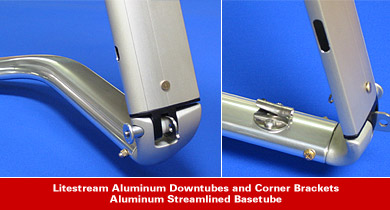
For 2003, Wills Wing released the Litestream control bar for performance oriented recreational pilots. The Litestream control bar combines the same low drag aluminum streamlined basetube used on the Slipstream control bar with a slightly shorter chord, lighter weight, easier to hold Litestream aluminum downtube.
The Litestream bar is standard equipment on Sport 3 glider, and optional on the T3.
The Litestream control bar can also be purchased as an add-on accessory for the Falcon 4 145, 170 and 195 models. The best control bar for high-performance recreational flying, the Litestream bar comes very close to matching the performance of the Slipstream bar, while saving 1.5 lbs in weight. The smaller profile makes ground handling and launching significantly easier, especially for pilots with smaller hands.
(For comparison purposes, the performance given up by dropping down from a Slipstream to a Litestream control bar is approximately equal to the performance that would be gained back by removing the coating from the bottom side wires. By comparison, moving up from an AT-style streamlined control bar with round basetube to a Litestream control bar does away with over 90% of the drag of the control bar, adding approximately one full point in L/D to the glider’s performance.)

The Wills Wing Slipstream Control Bar
Wills Wing was the first manufacturer to introduce an affordable aluminum high-performance control bar system: The Slipstream Control Bar. Featuring streamlined aluminum downtubes and interchangeable streamlined basetubes, it enabled pilots to select between aluminum and carbon components based on their performance needs, durability requirements, and budget.
Slipstream aluminum downtubes and basetubes retain a high percentage of the aerodynamic advantage of carbon fiber while offering significantly improved durability and reduced cost. This made high-performance control bars accessible to a much broader range of pilots and applications.
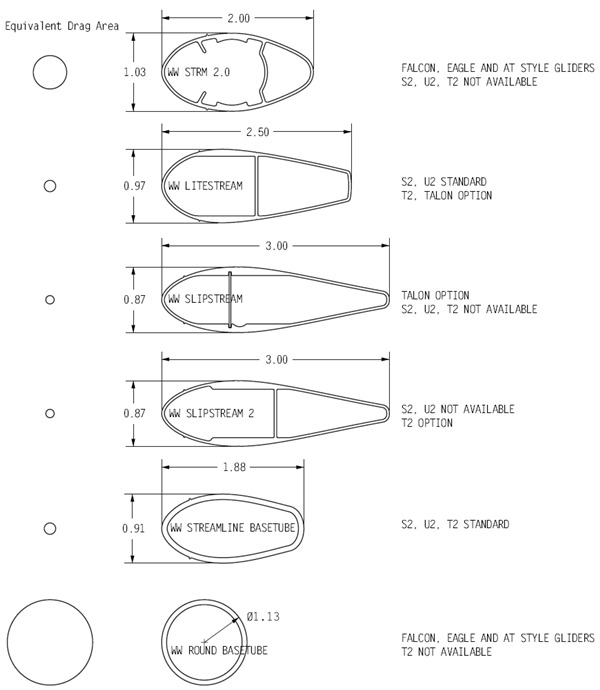
The illustration of the control bar section summarizes the significant differences in effective drag area (= performance) and geometry between the older AT style airfoil downtubes and the new Slipstream and Litestream sections.
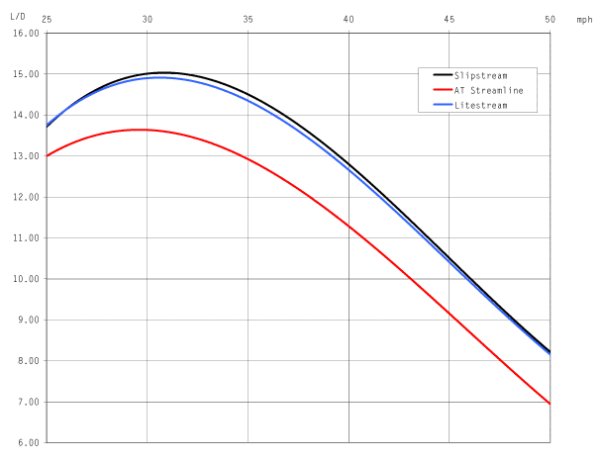
The performance comparison graph shows the relative L/D performance of the three types of control bars (mounted on a Talon) at various speeds (in mph).
Wills Wing Second Generation Carbon Speedbar
Redesigned for 2008 (Not available until further notice)
The new carbon speedbar will fit all gliders fitted with Slipstream or Slipstream 2 control bars. A Litestream compatible version is available for all gliders that have Litestream Control Bars. Features of the new carbon speedbar include a redesigned shape, with a deep offset planform. The grip positions are optimized for comfort, control and aerodynamics in all phases of flight. Specially designed flares in the grip area allow for effortless maintenance of optimum bank angle when thermalling.

Structural features include an extra-thick laminate constructed from aerospace-grade carbon and Kevlar pre-preg, cured at 230 degrees Fahrenheit and 105 psi pressure. A stainless steel internal safety cable and corner fittings machined from solid blocks of wrought aluminum ensure the structural reliability of the basetube.


Tandem Control Bar
The Wills Wing Tandem Control Bar is purpose-built for the Falcon Tandem glider and is standard equipment on that model. Designed to handle the significantly higher loads associated with tandem flight, it uses oversized 1.25-inch diameter downtubes with 0.095-inch wall thickness.
Specially designed machined aluminum corner fittings provide exceptional strength and durability, making the tandem control bar well-suited for repeated professional use in training and instructional environments.